Between Via delle Quattro Fontane and Piazza Barberini, just a short walk from the Quirinal and the Trevi Fountain, stands one of the most theatrical residences of 17th-century Rome. Palazzo Barberini is far more than a noble palace: it's a statement from a family that, once Maffeo Barberini was elected pope as Urban VIII, set out to leave its mark on the city.
Today its rooms house the National Gallery of Ancient Art (Galleria Nazionale d'Arte Antica), a collection spanning five centuries of European painting. Here you can stand face to face with Raphael's La Fornarina, Caravaggio's Judith Beheading Holofernes and the famous portrait of Henry VIII, on a route where Baroque architecture and great masterpieces go hand in hand.
Compared with other museums in the city, Palazzo Barberini is often far less crowded – and that's exactly what makes it such a rewarding stop if you like to take your time with art.
The history of Palazzo Barberini
The history of Palazzo Barberini begins in 1625, when Urban VIII bought a villa and vineyard on the slopes of the Quirinal from the Sforza family and handed the project to Carlo Maderno.
When Maderno died in 1629, Gian Lorenzo Bernini took over the building site, working alongside a young Francesco Borromini. It was a one-off moment in history: the two great rivals of the Baroque working on the same building, each leaving a mark you can still recognise today.
The result is a residence that breaks away from the closed layout of the Renaissance palazzo. Instead of a compact block around an inner courtyard, the H-shaped plan opens out towards the city, with a central loggia and two side wings – almost a country villa set down in the heart of Rome.
Its loggias, arches and stacked orders openly echo the theatres and amphitheatres of Classical Rome, reimagined with the freedom of a family eager to celebrate the new power of the popes.
Bernini's and Borromini's staircases at Palazzo Barberini
One of the most striking features of Palazzo Barberini comes before you even reach the galleries. On either side of the entrance hall rise two grand staircases that show the difference between the two masters better than any textbook.
On the left is Bernini's square staircase, monumental and solemn, with straight flights designed to escort cardinals and ambassadors up to the piano nobile.
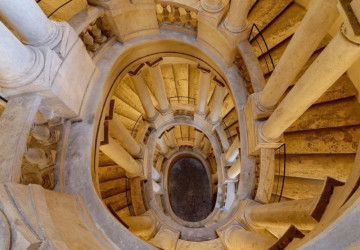
On the right, Borromini's oval spiral staircase winds upwards, its paired columns following the curve in one continuous movement. Look up from the bottom and the whole structure almost seems to breathe.
Climbing both is something of a ritual: in just a few steps you experience two completely different ways of thinking about Baroque space. As in many of the palaces of Rome rich in hidden symbols and inscriptions, every detail here speaks the language of the family who commissioned it.
Pietro da Cortona's ceiling at Palazzo Barberini
Up on the piano nobile you reach the great hall that is the true heart of the palace. Here, between 1632 and 1639, Pietro da Cortona painted the Triumph of Divine Providence, one of the most spectacular frescoes of the Roman Baroque.
The vault seems to dissolve into an open sky filled with allegorical figures. At the centre, Providence commands Immortality to crown the Barberini coat of arms, easy to spot thanks to the three bees that appear all over the building.
The best approach is to stand in the middle of the hall and let your eyes follow the movement of the figures, without rushing. Every corner hides virtues, allegories and references to Urban VIII's papacy.
In those same years, another papal family – that of Scipione Borghese – was gathering the masterpieces now on display in the Borghese Gallery in its villa on the Pincian Hill, in a contest of patronage that shaped the artistic face of the city.
What to see at Palazzo Barberini
There are plenty of masterpieces at Palazzo Barberini worth your attention. The National Gallery's collection covers everything from the 13th to the 18th century, laid out in chronological order.
One of the best-loved works is Raphael's La Fornarina, an intimate portrait of a young woman traditionally identified as the painter's lover. The artist's name is inscribed on the band around her arm.
Nearby you'll find works by Filippo Lippi, the delicacy of Lorenzo Lotto, the Venetian light of Titian and Tintoretto, and the elongated, visionary figures of El Greco.
Don't miss Hans Holbein the Younger's portrait of Henry VIII, perhaps the best-known image of the English king, and the portrait of Beatrice Cenci attributed to Guido Reni, linked to one of the most tragic stories of 16th-century Rome.
Caravaggio at Palazzo Barberini
The section that draws the biggest crowds is the one devoted to Caravaggio at Palazzo Barberini. Here the Lombard painter is represented by canvases that show the full force of his realism and his dramatic use of light and shadow.
The most famous is Judith Beheading Holofernes, a startlingly violent scene in which the biblical heroine beheads the Assyrian general with a look of both determination and revulsion.
Alongside it hang Saint Francis in Meditation and Narcissus, whose attribution is still debated by scholars but which remains one of the images most closely associated with the master.
These canvases are in dialogue with the other Caravaggio masterpieces in Rome kept in the churches of the historic centre, from San Luigi dei Francesi to Santa Maria del Popolo.
Palazzo Barberini and Galleria Corsini: one museum, two sites
Not everyone knows that the National Gallery of Ancient Art is split across two sites: as well as Palazzo Barberini, it includes the Galleria Corsini on Via della Lungara.
It was the Corsini collection, donated to the Italian State in 1883, that formed the museum's original core. The State only bought the palace on the Quirinal in 1949, gradually returning it to use as a gallery.
Galleria Corsini still keeps its 18th-century picture-gallery hanging, with canvases packed closely across the walls just as they were in the noble residences of the time.
The Via della Lungara site sits in the heart of Trastevere, the neighbourhood of narrow lanes and old-style osterias, pairing the Corsini collection with the city's most down-to-earth soul.
How long does a visit to Palazzo Barberini take?
One of the most common questions is how long you need to visit Palazzo Barberini. Around two hours is usually enough to see the main works, the staircases and Pietro da Cortona's great hall at a relaxed pace.
If you love Old Master painting, though, it's worth allowing a bit longer: there are plenty of rooms, and every period deserves your attention.
Step outside and you're in one of Rome's richest neighbourhoods. The palace is just minutes from the Baths of Diocletian, the Quirinal and Via Veneto, while the Trevi Fountain is only a short stroll away.
How to get to Palazzo Barberini
Palazzo Barberini is on Via delle Quattro Fontane, overlooking the square of the same name with Bernini's Triton Fountain. Barberini station on Metro Line A is just a few steps from the entrance.
From Termini, the Spanish Steps or the Trevi Fountain you can easily get there on foot too, walking along some of the most elegant streets in the centre.
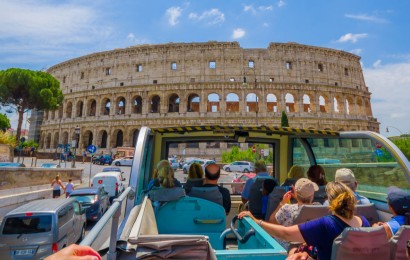
If you'd like to fit the visit into a wider itinerary without worrying about getting around, the Green Line Tours open-top bus stops right on Via Barberini, a stone's throw from the museum. With a single ticket you can hop on and off whenever you like and reach the city's other sights at your own pace.
Buy your Green Line Tours Hop-On Hop-Off ticket online and plan your day in Rome starting from Palazzo Barberini.