Rome is a city that never reveals itself entirely at first glance. Behind the elegant façades of Renaissance palaces, within quiet courtyards, and along less-traveled streets, there lies a language carved in stone: that of ancient symbols and inscriptions. These are not merely decorative elements, but true messages—visual codes and enduring testimonies of power, faith, belonging, and memory.
Walking through Rome with a trained eye means engaging with a millennia-old cultural layering. From the marks left by noble families to Latin inscriptions recounting long-forgotten events, every detail can become a discovery.
The hidden language of Roman façades
Many Roman palaces feature symbols that may appear purely ornamental at first glance. In reality, each element carries a precise meaning. Coats of arms, for example, tell the stories of the families who once inhabited these buildings. Eagles, lions, keys, towers—each figure represents a value or a defining episode tied to a lineage.
Walking near Palazzo Farnese or along the streets leading to Palazzo Venezia, it’s possible to notice carved details that reveal the prestige and ambitions of their owners. These symbols were never chosen at random; they communicated social status, political alliances, and family identity.
A trained eye may also recognize religious symbols hidden among decorative elements: stylized crosses, Christian monograms, or references to patron saints. In an era when imagery was a form of communication, every architectural detail became a way of expressing identity.
Latin inscriptions: memory carved in stone
Latin inscriptions are among the most fascinating—and often overlooked—elements. They can be found above doorways, embedded in walls, or integrated into architectural decorations. These are not simple writings; they are direct testimonies of the past, messages that have endured across centuries.
Many epigraphs contain celebratory phrases, dedications, or religious quotations. Some record the construction or restoration of a building, while others commemorate historical events or notable figures. Expressions like “SPQR” (Senatus Populusque Romanus) or “Anno Domini” are not just formulas—they are true temporal and political markers.
These inscriptions are often ignored, yet pausing to read—or simply observe—them means connecting with the direct voice of ancient Rome and the Renaissance. In some cases, translating even a short phrase can open a window onto forgotten histories.
Esoteric symbols and hidden meanings in the heart of Rome
Rome is not only about religion and political power. Hidden within its architectural details are also symbols linked to esoteric, alchemical, and philosophical traditions. They are not always easy to spot, but once recognized, they reveal a different narrative—less official, yet equally compelling.
On certain façades, one might identify elements such as five-pointed stars, serpents, hourglasses, and interwoven knots. These symbols often refer to concepts like time, transformation, and knowledge. In an era when alchemy and natural philosophy were widely practiced, such signs represented knowledge reserved for a select few.
A striking example can be found near the Porta Magica, one of the few surviving alchemical monuments in the city. Although not a palace in the traditional sense, it demonstrates how widespread the use of symbols as a secret code once was.
Hidden details in courtyards and doorways
One of the most common mistakes when visiting Rome is focusing only on the main façades. In reality, many of the most intriguing symbols are found in inner courtyards, entrance halls, and doorways.
Stepping inside certain historic buildings—when accessible—reveals a parallel world of frescoes, inscriptions, bas-reliefs, and decorative elements that often escape the attention of passersby. Doorways in particular are rich in detail: carved handles, plaques, engravings that tell the story of the building.
In areas such as the historic center or the Jewish Ghetto, near the Jewish Museum of Rome, one may come across inscriptions reflecting the presence of diverse communities and traditions. Here too, every mark has a specific meaning and contributes to the city’s cultural mosaic.
Seeing Rome with new eyes
Visiting Rome also means learning to look at it differently. Not just grand monuments and iconic landmarks, but also hidden details, subtle signs, and stories etched in stone.
To fully experience this dimension, it helps to explore the city in a way that allows you to notice its nuances—without rushing, and with the freedom to pause whenever something captures your attention.
What is the best way to explore Rome?
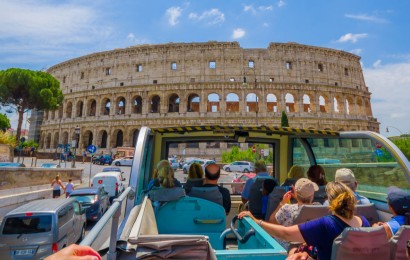
If you want to experience Rome in a practical and smart way—without missing any of its details, from major landmarks to hidden symbols—the hop-on hop-off service by Green Line Tours is an ideal solution.
With panoramic buses, you can move easily between the city’s main attractions, getting on and off whenever you like. This allows you to plan your itinerary independently, stop wherever your curiosity leads you, and dedicate time even to what often goes unnoticed.
Purchase your ticket with Green Line Tours and start exploring Rome with a new perspective—more attentive, more aware. Because sometimes, it’s the hidden details that make a journey truly unforgettable.