Visiting Rome means immersing yourself in an open-air museum, where every corner tells a story and every church hides an unexpected treasure. And among these treasures, few names shine as brightly as Caravaggio. The rebellious, restless, revolutionary Lombard genius left in Rome some of the most powerful works in the history of art—paintings that forever changed the way light and human drama were represented, and which you can admire without paying an entrance fee, simply by stepping inside a few churches in the heart of the city.
Whether you're an art enthusiast, a curious traveler seeking authentic emotions, or a visitor looking to enrich your Roman itinerary, this is one of the most rewarding routes you can take. Caravaggio in Rome is not just an art history topic—it’s a living, immediate, almost theatrical experience. And above all, it’s accessible, because many of his masterpieces are still exactly where he originally painted them, inside the chapels for which they were commissioned.
In this guide, you’ll discover where to see Caravaggio for free in Rome, which works await you, why they matter, and how to plan your itinerary in the best possible way.
Caravaggio in Rome: A Deep Bond
Caravaggio arrived in Rome at the end of the 16th century, after training in Milan and spending a turbulent period in Venice. The city—then the artistic capital of Europe—became both a springboard and a battleground for him. Between prestigious commissions and tavern brawls, between powerful patrons and condemnations, Rome is the place where his genius exploded and where his life took its most tormented turn.
It’s in the churches of the city that the revolution of chiaroscuro was born—the rejection of mannerist idealization and the bold rise of realism. His saints look like people encountered in the street; his martyrs have dusty, unwashed feet; his Madonnas are real women, full of grace but also grounded in truth.
And still today, because many of his works were never moved, we can experience Caravaggio as he intended: not on museum pedestals, but in direct dialogue with faith, candlelight, and the everyday life of worshippers.
Where to See Caravaggio for Free in Rome
The route for seeing Caravaggio for free in Rome centers around three main churches, all easy to reach and located in the core of the historic center. Each place preserves a cycle or series of works that represent crucial moments in the artist’s career.
San Luigi dei Francesi: The Calling of a Genius
San Luigi dei Francesi stands just a few steps from Piazza Navona. It's the kind of church you might stumble upon by chance while wandering through lively alleys and gelaterias—but once inside, it's unforgettable. The reason is simple: here lies one of Caravaggio's most important commissions, the Contarelli Chapel, dedicated to Saint Matthew.
Inside are three paintings that rewrote the history of Baroque art:
- The Calling of Saint Matthew, an absolute masterpiece of light, tension, and storytelling. The beam of light cutting in from the right seems to pierce the real space of the chapel.
- The Martyrdom of Saint Matthew, more complex and theatrical, showing the artist’s dramatic skill and ability to draw the viewer into the scene.
- Saint Matthew and the Angel, in its final version after the first—considered too “common”—was rejected.
Walking in feels like entering a movie scene: Caravaggio directs you with light, draws you into the moment, and forces you to become a witness.
Basilica of Sant’Agostino: A Popular Madonna
Just a few minutes from San Luigi dei Francesi, along Via della Scrofa, stands another essential destination for anyone wanting to see Caravaggio for free in Rome: the Basilica of Sant’Agostino.
Here you'll find the Madonna of the Pilgrims, one of the most controversial works of its time. The reason? A Madonna with dirty feet. Heresy to some, genius to others.
Caravaggio depicts Mary as an ordinary woman, caught at the moment she opens the door of her home to two kneeling pilgrims. Her feet are real—dusty from the road, marked by walking. The child watches the scene with curiosity. The light is warm and domestic.
The result is one of the most human, revolutionary, intimate paintings of Caravaggio’s entire production. And you can admire it freely, without queues or tickets.
Santa Maria del Popolo: The Power of Divine Light
At the entrance to Piazza del Popolo—one of Rome’s most iconic squares—stands Santa Maria del Popolo. Here, Caravaggio left two extraordinary masterpieces created for the Cerasi Chapel:
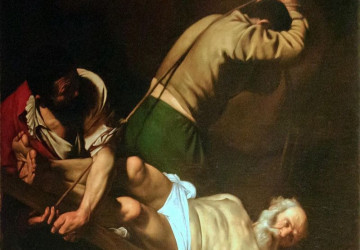
- The Crucifixion of Saint Peter, where the saint is lifted upside-down onto the cross. The executioners’ faces remain hidden, because the scene speaks through fatigue, gesture, and the weight of the body.
- The Conversion of Saint Paul, perhaps one of the painter’s most iconic images. A blaze of sudden light, a horse seemingly spilling out of the canvas, a fallen Paul struck by divine revelation.
Here Caravaggio reaches the purest synthesis of chiaroscuro, movement, and spirituality. The scene isn’t just told—it’s lived. The viewer becomes part of the narrative.
And once again, the entrance to the church is free.
Caravaggio in Rome: Suggested Itinerary
One of the advantages of this route is that all the churches are located within a relatively small area. You can visit all the Caravaggios for free in Rome in a single morning or spread your visits throughout the day as you explore the city.
A typical itinerary might start at Piazza del Popolo, continue down Via del Corso to visit Santa Maria del Popolo, then move toward the Pantheon and stop at Sant’Agostino, and finally end at San Luigi dei Francesi. It’s a route that blends art, architecture, local life, and some of Rome’s most picturesque views.
The best times to visit the churches are early morning or late afternoon, when crowds are thinner and you can enjoy the artworks in greater tranquility.
What’s the Best Way to See Caravaggio in Rome?
The most convenient and strategic way to explore Caravaggio’s works in Rome is to follow an itinerary that allows you to easily reach all the churches where his masterpieces are located. Even though the sites are fairly close, Roman traffic, pedestrian areas, and typical center-city detours can slow things down—especially during peak hours.
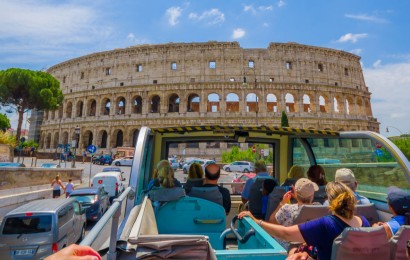
For this reason, many travelers choose to use a hop-on hop-off bus, which lets you move quickly between Piazza del Popolo, the Pantheon, Piazza Navona, and all the areas where Caravaggio’s churches stand. You can hop on and off whenever you want, stress-free, and optimize your time in Rome—spending more of it on the works of the Lombard master.
If you want a smooth, convenient, and well-planned itinerary to visit all the key Caravaggio stops, you can book the Green Line Tours hop-on hop-off ticket online: a practical, panoramic, and perfect solution to move easily between Caravaggio’s masterpieces and the city’s most iconic monuments.