For many travelers it is simply the port where ferries and cruise ships come and go, but anyone wondering what to see in Civitavecchia in one day will find a city with two thousand years of history, from papal fortresses and Roman baths to a seafront overlooking the Tyrrhenian Sea.
Its origins date back to the Etruscan era, while its ancient name, Centumcellae, is tied to the great harbor built by Emperor Trajan in the early 2nd century AD. Ever since, the sea has shaped the life of the city.
A well-planned day is enough to see the main sights: start from the historic port, walk through the old town and end with the sunset on the waterfront.
What to see in Civitavecchia in one day: where to start
The ideal starting point for a Civitavecchia itinerary is the historic port, still the heart of the city. Most of the main landmarks are concentrated here, just a short walk from one another.
This is where the Port of Trajan once stood, a harbor basin protected by breakwaters that for centuries handled the goods bound for Rome.
Along the docks you will also come across the Vanvitelli Fountain, designed in 1743 by Luigi Vanvitelli: carved entirely from travertine, it depicts the head of an old faun pouring water into the basin below.
Forte Michelangelo in Civitavecchia
The city's most iconic landmark is Forte Michelangelo in Civitavecchia, the fortress that guards the entrance to the port. Pope Julius II laid the first stone on December 14, 1508, and the work was completed in 1537 under Paul III.
The construction was directed by Antonio da Sangallo the Younger. The fort's name comes from a local tradition that credits Michelangelo with designing the keep, the large central tower, although there is no firm documentary evidence for it.
Its massive walls and bastions reflect Civitavecchia's strategic role as the main port of the Papal States, charged with defending the coast against attacks from the sea.
The National Archaeological Museum of Civitavecchia
Next to the fort stands the National Archaeological Museum of Civitavecchia, housed in an 18th-century palace commissioned by Pope Clement XIII as a garrison building.
Its rooms, spread over three floors, display Etruscan, Roman and medieval finds from the city and the surrounding area: pottery, bronzes, Etruscan bucchero ware, marble heads and a room devoted to Latin inscriptions.
One of the highlights is a statue of Apollo from the 1st century AD, around two meters tall. A visit usually takes about an hour and offers the clearest picture of the city's many historical layers before moving on.
The Taurine Baths in Civitavecchia
Outside the center, on an isolated hill a few kilometers from the sea, lie the Taurine Baths in Civitavecchia, also known as the Baths of Trajan. From up here the view opens onto the Tyrrhenian Sea.
The site has two distinct areas: the Republican baths, from the 1st century BC, and the Imperial baths, built between 123 and 136 AD. Marble floors, mosaics and heated rooms recall the great complexes of Classical Rome, on a smaller scale.
The name comes from a legend recorded in 416 AD by the poet Rutilius Namatianus: a bull, pawing the ground before a fight, is said to have brought forth a spring of hot, sulfurous water.
Like the Baths of Caracalla in Rome, these baths were a place for social life as well as for bodily care. Also outside the center, about 4 kilometers away, is the Ficoncella, where the ancient restored pools are still used for bathing in the thermal waters.
The historic center of Civitavecchia and the market
Heading back toward the sea, the historic center of Civitavecchia opens onto Piazza Leandra, the heart of the medieval quarter. Here you will find the Church of the Stella, the Ponte dell'Ospedale Vecchio and a medieval tower among the old palazzi.
Other churches worth seeing include the Cathedral of San Francesco d'Assisi and the Chiesa della Morte, while stretches of the city walls and the Porta dell'Archetto survive along the streets of the old town.
To get a feel for everyday life, stop at the San Lorenzo market around Piazza Regina Margherita, where every morning locals shop for fresh fish and local produce among stalls, cafés and trattorias.
The Church of the Holy Japanese Martyrs in Civitavecchia
One of Civitavecchia's most unexpected sights is the Church of the Holy Japanese Martyrs, dedicated to the Franciscans killed in Nagasaki in 1597. Consecrated in 1872, it was destroyed in a bombing raid on August 30, 1943, and reopened in 1950.
The interior is decorated with frescoes by the Japanese painter Luca Hasegawa, begun in 1950 and unveiled in 1954 at the initiative of Japan's representative to the Holy See.
The link with Japan goes back a long way: on October 18, 1615, the samurai Hasekura Tsunenaga landed in Civitavecchia as an ambassador on his way to Rome. His statue stands on Viale Guglielmo Marconi, near Porta Livorno, and since 1971 the city has been twinned with Ishinomaki, the port he had sailed from.
The Civitavecchia waterfront at sunset
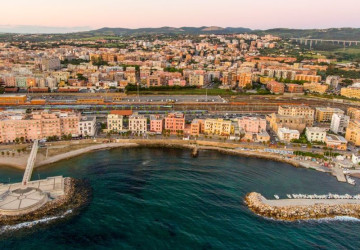
The day ends on the Civitavecchia waterfront, the promenade that runs from Forte Michelangelo to Borgo Odescalchi, passing the marina and the historic Pirgo bathing establishment, which juts out over the water.
The stretch has recently been redeveloped and hosts events and concerts around Piazza della Vita. Cafés and restaurants facing the sea make it the perfect spot to watch the sunset over the Tyrrhenian.
Before Civitavecchia, Rome's main port lay at the mouth of the Tiber, next to Ostia Antica: Trajan's new harbor was built precisely to support it and guarantee safer supplies to the capital.
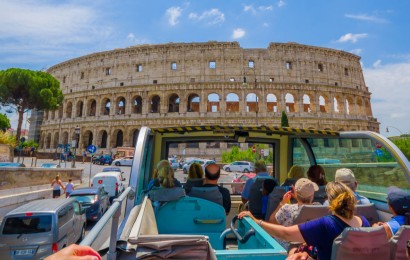
Discover Civitavecchia by bus with Green Line Tours
Forte Michelangelo, the archaeological museum, the old town and the waterfront are all within easy walking distance, but the Taurine Baths lie a few kilometers from the center and you need transport to reach them without losing precious time.
To see everything in a single day, the easiest option is the Green Line Tours hop-on hop-off bus, which stops at the city's main attractions, from Forte Michelangelo to the Cathedral and the Taurine Baths. With the daily ticket you can get on and off as many times as you like, from morning to evening.
On board you get an audio guide in 16 languages, free Wi-Fi and a city map, and in summer buses pass every 10-15 minutes at the main stops. Tickets bought online can be used within 15 days of booking, with no need to show up at a set time.
Plan your day and buy your Civitavecchia hop-on hop-off bus ticket to explore the city at your own pace.