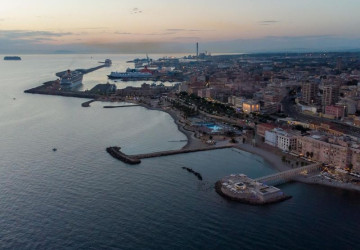
When you arrive in Civitavecchia today, especially by sea, it is easy to think of the port as a large modern infrastructure, serving commercial traffic and cruise tourism. Yet beneath the contemporary quays, breakwaters, and piers lies a much older story, one that reaches back to the Roman Imperial age. The origins of Civitavecchia are in fact inseparably linked to an ambitious project commissioned by Emperor Trajan, destined to reshape the maritime geography of the central Tyrrhenian Sea forever: the Port of Trajan, known in antiquity as Centumcellae.
To tell the story of this port’s foundation is to travel through centuries of history, touching on military strategy, Roman engineering, Mediterranean trade, and urban transformation. It is a journey that helps explain not only why Civitavecchia exists, but also the role it played—and continues to play—in the relationship between Rome and the sea.
Why Trajan Decided to Build a New Port
At the beginning of the 2nd century AD, Rome was a vast metropolis, with a population well exceeding one million inhabitants. Ensuring a constant supply of grain, oil, wine, building materials, and goods of every kind was an absolute priority. The port of Ostia, although expanded in earlier periods, showed clear structural limitations: silting, difficult access during rough seas, and insufficient space for the growing volume of maritime traffic.
It was in this context that Trajan decided to complement Ostia with a new major harbor, safer and better connected to the hinterland. The chosen site lay along a stretch of coast northwest of Rome, in a strategic position along the Tyrrhenian routes. Here the project of the port of Centumcellae took shape, conceived not as a simple landing place but as a fully fledged imperial infrastructure.
Centumcellae: the Ancient Name of Civitavecchia
The name Centumcellae appears in ancient sources to identify the settlement that grew around the port. The term, which can be translated as “one hundred chambers,” likely referred to the many vaulted spaces used as warehouses, storage facilities, and service areas. These structures were essential for the management of goods unloaded from ships and for their subsequent distribution to Rome.
Over time, Centumcellae developed into a true urban center, complete with public buildings, baths, residential areas, and road infrastructure. From here begins the history of Civitavecchia, whose modern name—meaning “old city”—ironically refers to a foundation that, at the time, was anything but ancient.
The Structure of the Port of Trajan
The Port of Trajan was a masterpiece of Roman engineering. Literary sources and archaeological remains suggest the presence of a harbor basin protected by curved breakwaters, designed to reduce the force of the waves and ensure access for ships even in adverse weather conditions. The use of Roman concrete, built with the technique of opus caementicium, made it possible to construct solid structures directly in the sea.
The port area was organized in a rational and efficient way: quays for docking, warehouses for storage, administrative spaces, and road connections leading inland. Everything was designed to make loading and unloading operations swift, minimizing the time ships spent in port and reducing the risks posed by storms.
A Key Hub for Mediterranean Trade
The Port of Trajan did not serve Rome alone; it was part of a commercial network spanning the entire Mediterranean. Goods arrived here from North Africa, Spain, Gaul, and the Eastern provinces. Egyptian grain, African oil, marble, spices, and luxury manufactures all passed through Centumcellae, which acted as a privileged redistribution hub.
This intense activity encouraged significant economic and demographic growth in the area. Craftsmen, merchants, sailors, and imperial officials helped form a dynamic, multicultural community, a small-scale reflection of the complexity of the Roman Empire itself.
The Connection with Rome and Communication Routes
One of the most important aspects of Trajan’s project was the direct connection with Rome. Roads and routes departed from the port, allowing goods to reach the capital quickly and efficiently. This integrated system of land and sea routes reduced logistical costs and increased the security of supplies.
The Port of Trajan thus functioned as a true “gateway to the sea” for Rome, strengthening imperial control over commercial routes and reinforcing the capital’s role as the economic and political center of the Roman world.
The Taurine Baths and Daily Life
Alongside the port infrastructure, the area of Centumcellae was enriched by major bath complexes, such as the Taurine Baths. These facilities, frequented by travelers, officials, and local residents, testify to a high level of urban development and an elevated quality of life.
Baths were not merely places for hygiene, but also centers of social life, business, and leisure. Their presence shows that Centumcellae was not just a technical harbor, but a living city, fully integrated into the Roman urban model.
From Roman Decline to the Middle Ages
With the crisis of the Roman Empire and the barbarian invasions, the Port of Trajan and the city of Centumcellae experienced a gradual decline. Without maintenance, port structures began to deteriorate, while the population decreased and moved to safer areas.
Throughout the Middle Ages, the settlement went through alternating phases of abandonment and revival, eventually evolving into the Civitavecchia we know today. Nevertheless, the memory of the Roman port never completely disappeared, resurfacing in historical records and archaeological remains.
Traces of the Port of Trajan in Civitavecchia
Walking through Civitavecchia and its surroundings, it is still possible to identify clear traces of the Roman past. Wall remains, submerged structures, and archaeological finds tell the story of Centumcellae and the Port of Trajan, offering a fascinating glimpse into the city’s origins.
These elements represent a cultural heritage of great value, allowing the territory to be read as a historical palimpsest, where each era has left its mark.
What Is the Best Way to Visit Civitavecchia
Visiting Civitavecchia means moving through Roman history, sea views, and testimonies that reveal the port’s strategic role across the centuries. To truly capture the essence of the city—especially when time is limited—the best option is to choose an experience that allows you to get oriented easily and reach the most significant sites without stress.
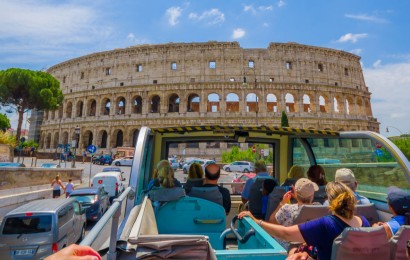
A hop-on hop-off ticket lets you explore Civitavecchia flexibly, getting on and off at the main stops to discover the port, the historic center, and key points of interest at your own pace. It is an ideal solution both for cruise passengers and for those seeking a first overall view of the city before delving deeper into its history.
To experience Civitavecchia with ease and organization, you can purchase the Green Line Tours hop-on hop-off ticket for Civitavecchia and turn your visit into a complete, practical, and comfortable experience, perfect for discovering the Roman origins of the city.