Rome is a city that naturally invites you to walk. Distances within the historic center are relatively short, the streets are full of history, and often all it takes is turning a corner to suddenly find yourself in front of a Baroque square, a monumental fountain, or a fragment of ancient Rome. Visiting Rome on foot is one of the most authentic experiences you can have during a trip to the Italian capital.
At the same time, however, Rome is also a vast, complex city and surprisingly demanding to explore entirely on foot. Between cobblestone streets, sudden hills, very large neighborhoods, and intense tourist flows, planning your movements carefully becomes essential.
Understanding how realistic it is to walk around Rome, which areas are truly close to one another, and when it makes sense to alternate walking with transportation can make the difference between a pleasant visit and a tiring day.
In this guide, we explore what you should know before visiting Rome on foot: the real distances between monuments, the areas that are easiest to explore, common mistakes, and practical tips for moving around the city more efficiently.
Is Rome really a city to explore on foot?
The answer is yes, but with some clarifications. The historic center of Rome is relatively compact and many of the most famous attractions are within walking distance. In about twenty minutes it is possible to move between some of the most iconic places in the city.
For example:
- Pantheon → Piazza Navona: about 5 minutes
- Piazza Navona → Campo de' Fiori: about 7 minutes
- Trevi Fountain → Spanish Steps: about 10 minutes
- Spanish Steps → Villa Borghese: about 12 minutes
This makes the historic center perfect for slow exploration, without rushing, simply letting the streets and squares guide you.
The real limitation appears when trying to connect attractions that are farther apart. Rome is not a small city: from the Colosseum to the Vatican Museums there are almost 4 kilometers, which easily turns into more than 45 minutes of continuous walking.
For this reason, even visitors who love walking often alternate walks through the historic center with public transport or sightseeing buses.
The best areas of Rome to explore on foot
Some neighborhoods in the city are particularly suited to being explored on foot. In these areas, the density of monuments, squares, and scenic corners makes every walk extremely rewarding.
The historic center of Rome
The area between the Pantheon, Piazza Navona, Campo de' Fiori, and the Trevi Fountain is probably the most enjoyable part of Rome to explore on foot.
Here, distances are short and every street tells part of the city's story: Renaissance palaces, Baroque churches, small hidden squares, and monumental fountains.
Walking in this area means constantly discovering new details, often away from the busiest tourist routes.
The Colosseum and Imperial Forums area
Another perfect area for walking is the one surrounding the Colosseum, Roman Forum and Palatine Hill.
Here the atmosphere of the city changes completely: spaces become wider and the landscape is dominated by the ruins of ancient Rome. Walking along Via dei Fori Imperiali allows you to literally cross two thousand years of history.
Many visitors choose to continue on foot to Piazza Venezia, where the imposing Altare della Patria stands.
Trastevere
For those who enjoy walking without a specific destination, Trastevere is one of the most fascinating neighborhoods in Rome.
Its narrow streets, colorful buildings, and small squares create an atmosphere completely different from the monumental city center. It is the perfect place for an evening walk, perhaps stopping at a trattoria or in a lively square.
Here too, distances are relatively short, and the neighborhood lends itself well to slow exploration.
How much walking you actually do when visiting Rome
Many travelers underestimate one aspect: visiting Rome often means walking much more than expected.
During a day of sightseeing, it is normal to walk between 10 and 15 kilometers, especially if you visit museums, monuments, and different neighborhoods.
This happens for several reasons:
- many streets in the historic center are pedestrian-only
- monuments are distributed across different areas of the city
- traffic often makes walking faster than taking a taxi
In addition, the cobblestone paving known as sampietrini can make walking more demanding than in many other European cities.
For this reason, wearing comfortable shoes and planning realistic itineraries is essential.
The most common mistakes when visiting Rome on foot
Although walking is the best way to experience the city, some mistakes can make the experience less enjoyable.
Trying to see everything in one day
Rome is an enormous city. Trying to visit the Colosseum, the Vatican, the historic center, and Trastevere in the same day often means spending more time walking than actually enjoying the places.
A better approach is to divide the city into areas and dedicate each day to a specific neighborhood.
Underestimating distances
On the map many attractions appear close to one another. In reality, however, routes are not always direct and often include hills, busy intersections, or detours.
For example:
- Colosseum → Spanish Steps: about 30 minutes on foot
- Colosseum → Vatican: almost one hour of walking
Knowing this in advance helps avoid overly exhausting itineraries.
Not considering the heat
During the summer months, walking long distances in central Rome can become challenging. Temperatures often exceed 35°C (95°F), and many streets offer little shade.
In summer it is advisable to:
- start walking early in the morning
- take frequent breaks
- alternate walking with transportation
What is the best way to visit Rome
Visiting Rome on foot is undoubtedly one of the most authentic ways to experience the city, but alternating walks with faster transportation can make the experience far more enjoyable.
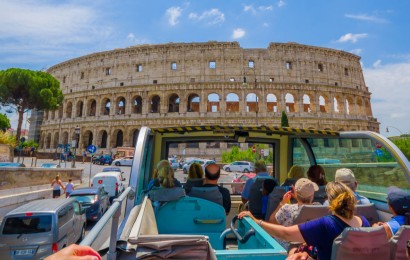
A particularly practical option is using the Hop On Hop Off service by Green Line Tours, which allows you to move easily between the main attractions of the capital without having to cover long distances on foot.
Thanks to stops at the most iconic points of the city, you can get off near the monuments, explore the area on foot, and then hop back on the bus to reach the next stop. This way you can see much more, with less effort and with a complete overview of the city.
If you are planning your itinerary in the capital, purchasing a Hop On Hop Off ticket from Green Line Tours can be the ideal solution to discover Rome with greater freedom and organize your sightseeing days more efficiently.