Rome is a city that tells its story even through stone. Among its most enigmatic and fascinating monuments are undoubtedly the obelisksof Rome: ancient structures that combine religious symbolism, political propaganda, and extraordinary engineering. Brought from Pharaonic Egypt or created during the imperial era, obelisks punctuate squares, hills, and gardens, becoming visual and cultural landmarks.
Walking through the city, you may come across these tall monolithic columns without really wondering where they come from or why they are there. Yet every obelisk has a precise story, often adventurous, spanning millennia: from the cult of the Sun in ancient Egypt, to the triumph of imperial Rome, and finally to the symbolic rediscovery promoted by Renaissance popes.
What Is an Obelisk and Why It Originated in Egypt
The obelisk originated in ancient Egypt as a solar symbol. Its slender shape, topped by a pyramidal point called a pyramidion, represented a petrified ray of sunlight. It was not merely decorative: the obelisk was consecrated to the god Ra and placed in front of temples as a sign of connection between heaven and earth.
Carved from a single block of granite, often quarried in Aswan, the obelisk was already an impressive technical feat for the Egyptians. Its surfaces were engraved with hieroglyphs celebrating the commissioning pharaoh, reinforcing his link to the divine and his legitimacy to rule.
Why Rome Is Full of Obelisks
The widespread presence of obelisks in Rome is the result of a deliberate political choice. After the conquest of Egypt in 30 BC, Rome absorbed not only a strategic territory but also its powerful symbolic apparatus. Bringing obelisks to Rome meant appropriating the prestige of the pharaohs and demonstrating that the Empire was the new center of the world.
Roman emperors had these colossal monuments transported by sea and along the Tiber, placing them in symbolic locations such as circuses, temples, and mausoleums. Later, between the 16th and 17th centuries, the popes recovered many obelisks that had fallen or been buried, transforming them into key elements of Christian Rome.
The Most Famous Obelisks of Rome
The Vatican Obelisk: From Pagan Symbol to the Heart of Christianity
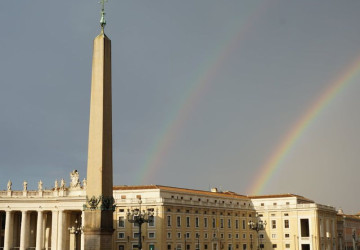
The most famous obelisk is the one that dominates St. Peter’s Square. Known as the Vatican Obelisk, it is one of the few in Rome without hieroglyphs, as it was made during the Roman era.
Originally located in the Circus of Caligula and Nero, not far from where Saint Peter is traditionally believed to have been martyred, it was moved in 1586 by order of Pope Sixtus V to the center of the square. The operation, led by architect Domenico Fontana, was a masterpiece of Renaissance engineering: hundreds of men, winches, and horses were required to lift a monolith weighing over 300 tons.
From that moment on, the obelisk became a symbolic axis of Christianity, reinterpreting a pagan monument as a sign of the Church’s victory over the ancient world.
The Flaminio Obelisk in Piazza del Popolo
At the center of Piazza del Popolo stands the Flaminio Obelisk, one of the oldest in Rome. It was made in Egypt during the reign of Ramses II and brought to Rome by Augustus in 10 BC to celebrate the subjugation of Egypt.
Originally located in the Circus Maximus, the heart of chariot racing, it was moved to the square only in the 16th century. Here, the obelisk takes on a precise urban role: welcoming those who enter Rome, like an ancient signal of power and order.
The Lateran Obelisk: The Largest in Rome
The Lateran Obelisk is the tallest and heaviest among Rome’s obelisks. It comes from Karnak and was erected under Pharaoh Thutmose III. Constantine ordered it to be transported to Rome, but it was his son Constantius II who placed it in the Circus Maximus.
Today it stands in front of the Basilica of St. John Lateran, dominating the square as a direct testament to pharaonic grandeur. Its hieroglyphs celebrate the god Amun and the power of the ruler, making it one of the oldest historical documents visible in Rome’s urban space.
The Montecitorio Obelisk and Time
The Montecitorio Obelisk had a unique function. In the Augustan era, it was part of a gigantic solar meridian, the Horologium Augusti. The shadow cast by the obelisk marked the passing of the seasons, linking cosmic time to the emperor’s power.
Even today, in front of Montecitorio, the obelisk recalls the bond between astronomy, politics, and propaganda. It was not just a monument: it was a way of stating that the order of time itself depended on Rome.
The Minerva Obelisk: Bernini’s Elephant
One of the most curious is the obelisk in Piazza della Minerva, supported by a small elephant sculpted by Gian Lorenzo Bernini. The work, ironic and learned at the same time, combines ancient wisdom with Baroque creativity.
Placed in front of the church of Santa Maria sopra Minerva, the obelisk becomes a metaphor for knowledge: wisdom (the obelisk) needs a solid base (the elephant) to stand. It is one of the most successful examples of Christian and artistic reinterpretation of a pagan symbol.
The Other Obelisks of Rome
Rome is home to thirteen ancient obelisks, more than any other city in the world. Some are located in lesser-known places, such as Villa Celimontana or Trinità dei Monti, while others rise in monumental settings like Piazza Navona or the Circus Maximus.
This distribution is not random: obelisks have been used as urban landmarks, scenic elements, and signs of continuity between different eras. Every relocation, every new placement, tells a precise vision of the city.
What Is the Best Way to Visit the Obelisks of Rome
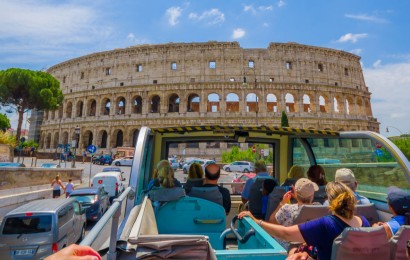
Rome’s obelisks are scattered throughout the city, often far apart and set within very different urban contexts. For this reason, the most convenient and effective way to visit them is to choose a hop-on hop-off sightseeing bus, which allows you to move quickly between major squares and stop wherever you wish to explore further.
A practical option is the Green Line Tours hop-on hop-off panoramic bus, designed for those who want to explore Rome flexibly, with an onboard audio guide and stops at key points in the historic center. It’s the ideal way to discover the obelisks without stress, optimizing time and distances while enjoying an overall view of the city. Get off at the stop that interests you, observe the obelisk in its historical context, take photos, and continue your journey without having to plan every move.
Buy your Green Line Tours hop-on hop-off ticket now and visit Rome’s obelisks with complete freedom, hopping on and off at the city’s main stops without stress.