Rome is a city that never stops surprising—even those who think they know it inside out. Beyond its most famous landmarks, there is a quieter side of Rome, made of symbols, enigmas, and forgotten stories. Among these mysterious places, the Magic Door stands out: a one-of-a-kind architectural element that seems to belong more to an esoteric tale than to a city square.
Located in the heart of the Esquilino district, the Magic Door is the only surviving remnant of a 17th-century villa and still represents one of the most fascinating enigmas in the capital. Enigmatic engravings, alchemical symbols and cryptic inscriptions make it a reference point for history enthusiasts, esotericism lovers, and curious travelers looking for something beyond the usual tourist routes.
But what does this door really represent? And why does it continue to exert such a powerful fascination?
Where is the Magic Door in Rome?
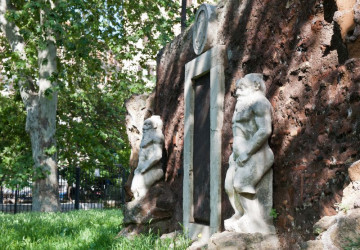
The Magic Door is located within the gardens of Piazza Vittorio Emanuele II, in the Esquilino neighborhood—a central area that is often overlooked compared to more traditional tourist routes. It stands in a green space, surrounded by other symbolic elements, including two statues of the Egyptian god Bes, which add to the already evocative atmosphere.
This door is not there by chance. It originally belonged to Villa Palombara, the residence of Marquis Massimiliano Palombara, a 17th-century Roman nobleman with a deep interest in alchemy. Today, almost nothing remains of the villa, but the door has survived time and urban transformation, becoming a unique testament to an era when science, philosophy, and magic were deeply intertwined.
Getting there is quite easy: the square is well connected and just a few minutes from Termini Station. However, what truly makes this visit special is not its accessibility, but the sense of discovery you experience when standing before something so unusual within a modern urban setting.
What is the legend of the Magic Door?
The story of the Magic Door is closely tied to a fascinating and mysterious legend. It is said that Marquis Palombara often hosted scholars, philosophers, and alchemists from all over Europe in his villa. Among them, one in particular is believed to have left an indelible mark.
According to tradition, a foreign alchemist—often described as a mysterious, almost legendary figure—managed to discover the formula to transform metal into gold. One night, while working in the villa’s gardens, he successfully carried out the experiment. At dawn, however, he suddenly disappeared, leaving behind only a few traces: golden flakes and a sheet covered in incomprehensible symbols.
Fascinated and obsessed by the event, the marquis had those symbols engraved on a door of his villa, hoping to decipher the secret of alchemical transformation. This is how the Magic Door came into being, also known as the Alchemical Door or Hermetic Door.
This legend, suspended between reality and imagination, contributes to making the Magic Door one of the most enigmatic places in Rome, where history and myth are inseparably intertwined.
What is the meaning of the Hermetic Door?
To truly understand the Magic Door, it is necessary to enter the world of alchemy—a discipline that combined elements of philosophy, spirituality, and proto-science. Alchemy was not simply about transforming metals, but about a symbolic journey of inner evolution.
The Hermetic Door represents precisely this: a passage, not so much physical as symbolic, toward deeper knowledge. The term “hermetic” derives from Hermes Trismegistus, a mythical figure associated with ancient wisdom and the secrets of the universe.
The inscriptions on the door are not random, but follow a precise symbolic language. They are formulas, mottos, and references that speak of transformation, purification, and rebirth. In this sense, the door can be interpreted as an invitation to move beyond the limits of ordinary knowledge and access a higher level of awareness.
It is no surprise that scholars and enthusiasts still attempt to decipher its meaning, finding in the Magic Door an open and enduring enigma.
What are the alchemical symbols of the Magic Door of Rome?
One of the most fascinating aspects of the Magic Door is undoubtedly the presence of numerous alchemical symbols carved into its surface. These symbols are not decorative, but part of a coded language understood by only a few.
Among the most intriguing elements are:
- Latin formulas referring to alchemical principles
- Planetary symbols associated with metals
- References to the philosopher’s stone
- Representations of the transformation of matter
Each engraving seems to narrate a part of the alchemical process, from raw matter to its final purification. However, the overall meaning remains open to interpretation even today.
A particularly curious detail is that the door was not meant to be crossed in the conventional sense. It did not lead to a specific place, but rather embodied a concept: the transition from one state to another, from superficial knowledge to deeper understanding.
This makes it unique within Rome’s architectural landscape and sets it apart from any other monument in the city.
How to reach the Magic Door in Rome?
Visiting the Magic Door is an experience well worth having, especially for those who want to discover a different side of Rome, far from the most predictable routes.
The easiest way to get there is by reaching Piazza Vittorio Emanuele II, which is easily accessible by public transport or through convenient sightseeing options designed to explore the city without stress.
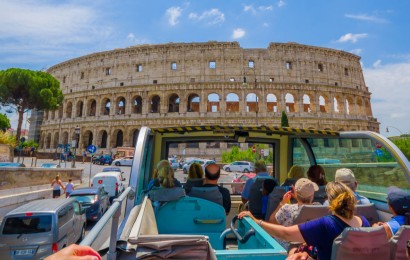
One of the most practical solutions is the hop-on hop-off service by Green Line Tours, which allows you to move between Rome’s main attractions with complete flexibility. You can get on and off whenever you like, building your itinerary in a simple and efficient way.
To visit the Magic Door, simply get off at Stop 2 (Santa Maria Maggiore). From there, it’s about a 5-minute walk to Piazza Vittorio and the entrance to the gardens where the door is located.
If you’re planning your itinerary, purchasing a Green Line Tours ticket allows you not only to explore Rome’s iconic landmarks, but also to include lesser-known stops like this one, without any hassle in getting around.
Buy a ticket with Green Line Tours, choose your route, hop on board, and let yourself be guided through a more authentic Rome, where even an enigmatic place like the Magic Door becomes part of a complete experience.