The Pantheon, a must-see for anyone visiting Rome, is one of those places that leaves a deep impression even on those who only spend a few minutes inside. You only need to step through its doors, look up at the dome, and watch the light pouring in through the oculus to understand that there is nothing else like it in the world. Yet its story is not just that of an architectural masterpiece—it is a layered narrative of religion, political power, urban transformation and cultural interpretation that has evolved over nearly two thousand years.
This article retraces the entire history of the Pantheon, from its origins as a pagan temple dedicated to all gods to its Christian consecration.
The Origins of the Pantheon and the Meaning of Its Name
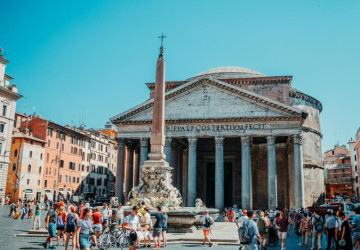
The story of the Pantheon begins under Augustus, at a time when Rome was redefining its identity after decades of civil war. The first building was erected by Marcus Agrippa, the emperor’s son-in-law and closest ally. His contribution is still visible in the inscription on the façade: M·AGRIPPA·L·F·COS·TERTIVM·FECIT (“Marcus Agrippa, son of Lucius, consul for the third time, built this”).
The name “Pantheon” comes from the Greek pan (all) and theon (gods). This does not necessarily mean that the temple was dedicated to every divinity without distinction. Some historians believe it was a symbolic structure honoring the imperial family and its protective deities. Others suggest the name referred to its circular shape, evoking the heavenly vault—the “dwelling place” of the gods.
Whatever its original purpose, Agrippa’s Pantheon is not the building we see today: it was destroyed by a fire in 80 AD, rebuilt, and later damaged again.
Hadrian’s Pantheon: An Architectural Revolution
The Pantheon as we know it today is the result of Emperor Hadrian’s reconstruction between 118 and 125 AD. This marks the beginning of the most fascinating chapter in its history. Hadrian chose not to place his own name on the monument, preserving the original dedication to Agrippa, yet he completely revolutionized its design.
The resulting structure is unlike any other Roman temple:
- A perfectly cylindrical rotunda.
- A hemispherical dome whose height is identical to its diameter: 43.3 meters.
- A central oculus measuring 9 meters across, illuminating the interior with natural light.
This perfect geometry was intentional: it symbolized cosmic harmony. For the Romans, the sphere represented perfection, and the circle was a sacred form often associated with divinity.
How Is the Dome of the Pantheon Built?
The dome is made of concrete that becomes progressively lighter toward the top. The lower parts contain heavier materials like travertine, while higher sections incorporate tuff and pumice, which are much lighter. The interior coffers are not merely decorative—they further reduce the overall weight. The oculus, in addition to providing light, also reduces the load at the most critical point of the structure.
Even today, nearly two thousand years later, this remains the largest unreinforced concrete dome in the world. Its flawless stability demonstrates a level of engineering sophistication that continues to astonish modern specialists.
What Was the Pantheon Used For in Ancient Rome?
When discussing the original function of the Pantheon, sources are not always clear. It was not a traditional temple: it had no exterior altars, nor did its layout follow canonical temple design. Many scholars believe it served as a space for imperial ceremonies and cults, reinforcing the symbolic connection between the emperor and the gods.
Another theory suggests that it was used as a political and ceremonial venue, rather than a strictly religious one. What is certain, however, is that the Pantheon was regarded as a unique building—both for its architecture and for the cosmic symbolism evoked by its circular form and overhead light.
Its monumental scale had no precedent in Roman architecture. Over the centuries, it inspired countless structures: from Brunelleschi’s dome in Florence to Michelangelo’s dome for St. Peter’s.
From Paganism to Christianity: The Birth of Santa Maria ad Martyres
In 609 AD, the Byzantine emperor Phocas donated the Pantheon to Pope Boniface IV, who consecrated it as a Christian basilica dedicated to Santa Maria ad Martyres. This consecration was a highly significant political and religious act: transforming the most symbolic pagan structure of ancient Rome into a church represented both continuity and a profound cultural shift.
Because it was converted into a basilica, the Pantheon was spared the fate of many ancient Roman buildings, which were often abandoned or dismantled for materials. Although some exterior elements were lost over the centuries—often removed for bronze or stone—the main structure remains remarkably intact.
For example, the bronze beams from the portico were removed in the 1600s by order of Pope Urban VIII Barberini. This episode gave rise to the famous Roman saying: “Quod non fecerunt barbari, fecerunt Barberini” (“What the barbarians did not do, the Barberini did”).
What Does the Pantheon Represent Today?
Today, the Pantheon is simultaneously:
- a place of worship, with regular religious services;
- a symbol of ancient Rome;
- a national monument housing the tombs of artists and Italian monarchs.
Among the most notable figures buried here are Raphael and two kings of the House of Savoy, Victor Emmanuel II and Umberto I, along with Queen Margherita.
Pantheon and Architecture
The greatness of the Pantheon lies not only in its history and symbolism but also in its extraordinary engineering precision. Every detail harmonizes function, shape, and meaning:
- The inner cylinder follows perfect mathematical proportions.
- Materials are distributed strategically to balance weight and stability.
- The dome appears weightless due to the oculus, which visually cancels its mass.
- The geometry creates an almost “divine” spatial perception.
This fusion of science and symbolism makes the Pantheon a timeless reference for architects, art historians, and engineers worldwide.
The Pantheon in the Middle Ages and the Renaissance
During the Middle Ages, the Pantheon became a reference point for the Roman community. As a basilica, it was regularly used and maintained. Still, its scale and design continued to amaze medieval scholars, who often considered it impossible to imitate.
In the Renaissance, admiration for the Pantheon soared. Artists such as Brunelleschi, Michelangelo, and Leon Battista Alberti studied it extensively. Michelangelo famously declared that the Pantheon was “designed by angels, not by man.”
Its influence can be seen in monumental buildings across the world—from the Florence Cathedral to the U.S. Capitol in Washington, and countless churches and public buildings throughout the Western world.
The Best Way to Reach the Pantheon
Reaching the Pantheon is simple, as it sits in the heart of Rome’s historic center, but navigating pedestrian streets, restricted-traffic zones, and walking distances can be challenging if you are short on time or planning to see multiple landmarks in one day. The most convenient and stress-free way to get there is by using a service that allows you to move freely among the city’s major attractions, without relying on expensive taxis or long walks.
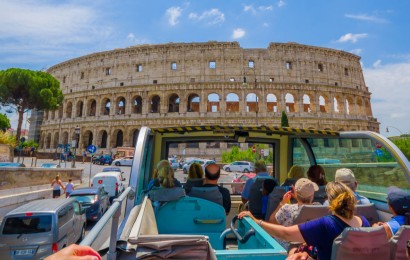
This is why many travelers choose hop-on hop-off buses: you can get off at the closest stop, explore the Pantheon at your own pace, and then hop back on whenever you’re ready to continue your itinerary.
If you want to add easy transportation, panoramic views from the top deck, and a route designed to cover all of Rome’s must-see sights, you can purchase your Green Line Tours hop-on hop-off ticket online, making Rome effortlessly accessible throughout your visit.