The Jewish Ghetto of Rome is one of the places most steeped in memory, culture, and historical layers in the entire city. Located between the Tiber River and the Theatre of Marcellus, in the oldest heart of the Capital, this district tells the story of more than two thousand years of uninterrupted Jewish presence — the oldest in Europe. Walking through its streets means crossing different eras: from ancient Rome to the papal age, from persecution to rebirth, up to today’s vibrant life shaped by religious traditions, identity-driven cuisine, and cultural pride.
Today, the Ghetto is not only a tourist destination but a living, inhabited, and deeply symbolic place. Understanding its history offers a way to read Rome from a different perspective, less monumental and more human — one shaped by resilience, memory, and identity.
The Origins of the Jewish Community in Rome
Jewish presence in Rome dates back at least to the 2nd century BCE, when merchants and prisoners of war arrived in the capital of the Empire. Over time, the community became firmly rooted, integrating into the urban fabric while maintaining its own religious and cultural traditions. During the imperial era, Jews lived mainly in the Trastevere area and near the river — districts that were peripheral at the time but strategic for trade.
After the destruction of the Temple of Jerusalem in 70 CE, Rome became one of the main centers of the Jewish diaspora. Over the centuries, the community contributed to the city’s economic and cultural life, developing synagogues, schools, and autonomous institutions. This long historical continuity is what makes the Roman Ghetto unique compared to other European Jewish quarters, many of which were established much later.
The Creation of the Ghetto in the 16th Century
The Jewish Ghetto of Rome was officially established in 1555 by Pope Paul IV through the bull Cum nimis absurdum. Jews were forced to live within a walled area with gates locked at sunset and guarded by papal authorities. Living conditions were extremely harsh: overcrowding, frequent flooding due to the proximity of the Tiber, and severe restrictions on employment.
Despite these limitations, the community developed a strong internal identity. Synagogues, confraternities, and an autonomous social system emerged to support the most vulnerable. The five historic synagogues, known as the “Cinque Scole,” represented the different liturgical traditions within the community.
Life in the Ghetto was marked by humiliating obligations, such as wearing distinctive signs and being forbidden to own property outside the designated area. Yet it was precisely under these conditions that a powerful sense of belonging took shape — one that would endure for centuries.
Emancipation and Transformation After Italian Unification
The end of the Ghetto came in 1870, with the capture of Rome and its annexation to the Kingdom of Italy. The walls were demolished, and Jews gained full civil rights. The district changed profoundly: many buildings were torn down for hygienic and urban planning reasons, making way for more modern structures and the embankments along the Tiber.
A symbol of this new era was the construction of the Great Synagogue, inaugurated in 1904. With its distinctive square dome, it still represents the pride of the community and the end of centuries of segregation.
Next to the Great Synagogue stands the Jewish Museum of Rome, which preserves valuable testimonies of the community’s religious and cultural life. Here visitors can admire ritual textiles, manuscripts, and liturgical objects that tell a millennia-long story.
The 20th Century Between Tragedy and Memory
The 20th century brought new trials. During the Fascist period, the racial laws of 1938 severely affected Italian Jews. The most tragic moment came with the roundup of October 16, 1943, when more than a thousand people were deported to Auschwitz. Only a small number returned.
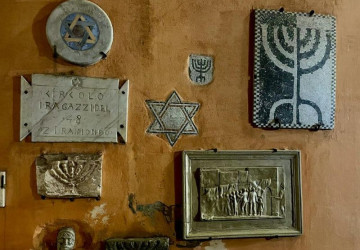
Today, the district preserves numerous stumbling stones and memorials commemorating the victims of the Shoah. Memory is an integral part of the Ghetto’s identity — not as a symbol of closure, but as a warning and a historical testimony.
The Rome Ghetto Today: Culture, Traditions, and Judeo-Roman Cuisine
Today, the Jewish Ghetto of Rome is also famous for its cuisine, one of the most authentic expressions of Judeo-Roman tradition. Dishes such as carciofi alla giudia — crispy, golden fried artichokes — and fried cod fillets tell the story of centuries of culinary adaptation to kosher rules and locally available ingredients.
Cuisine thus becomes a bridge between past and present, capable of keeping traditions alive within a constantly evolving urban context. The restaurants of the Ghetto are frequented by both Romans and visitors from around the world, drawn by a unique gastronomic experience.
Alongside gastronomy, the district hosts schools, bookstores, cultural institutions, and artisan activities that testify to the vitality of the contemporary community.
How to Reach the Jewish Ghetto of Rome
Visiting the Jewish Ghetto is easy thanks to its central location, but navigating traffic, restricted zones, and parking can be complicated. A practical solution is to use a tourist service that allows you to move comfortably between the city’s main points of interest.
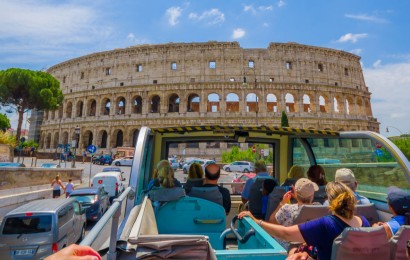
A strategic way to reach the district and continue exploring Rome stress-free is to purchase a ticket for the Green Line Tours hop-on hop-off bus.
This service allows you to get on and off freely at stops near major attractions, optimizing your time and turning transportation into part of the experience. After exploring the Ghetto, you can continue toward the Colosseum, the Vatican, or Piazza di Spagna with the same ease, enjoying the city’s panorama comfortably on board.