Walking through Rome, it’s easy to come across long stretches of ancient walls that seem to emerge almost by chance among modern buildings, parks, and busy streets. These are the Aurelian Walls, one of the most imposing and best-preserved defensive systems of antiquity. They are not just a military structure: these walls tell the story of a crucial moment in Rome’s history, when the city—once the invincible center of the Empire—began to perceive its own vulnerability.
Understanding what the Aurelian Walls are means reading between the lines of the third-century crisis, interpreting the defensive strategies of an empire in transition, and discovering how Rome adapted to new threats. But more simply, it also means learning to look at the city with different eyes.
What the Aurelian Walls Are and Why They Were Built
The Aurelian Walls were built between 271 and 275 AD under the orders of Emperor Aurelian, during a historical period marked by political instability, barbarian invasions, and economic crisis. Until then, Rome had never needed such an extensive defensive circuit: its security was guaranteed by the military power of the Empire, which kept enemies far from its borders. But something was changing.
The increasingly frequent raids by Germanic populations had shown that not even the capital was safe. For this reason, Aurelian decided to protect Rome with a wall approximately 19 kilometers long, designed to enclose not only the historic center but also peripheral areas, barracks, warehouses, and strategic infrastructure.
This decision already says a lot: Rome was no longer an invulnerable city, but a metropolis that needed to defend itself.
How Long They Are and How They Were Built
The Aurelian Walls stretch for about 18.8 kilometers, making them one of the largest defensive works of the ancient world. Originally, they were between 6 and 8 meters high, but were later raised to reach up to 16 meters in some sections, especially during the reign of Honorius in the 5th century.
From a construction standpoint, the walls feature typical elements of Roman engineering:
- a structure made of brick (laterizio) and Roman concrete
- defensive towers placed at regular intervals
- internal walkways for soldiers
- monumental gates serving as the main access points to the city
One of the most interesting aspects is that, to speed up construction, pre-existing buildings were incorporated into the structure. A famous example is the Pyramid of Cestius, which was directly integrated into the defensive system, effectively becoming a bastion.
This detail reveals an extremely pragmatic approach: the urgency of construction was such that functionality was prioritized over aesthetics.
The Main Gates of the Aurelian Walls
The walls were interrupted by numerous gates, some of which are still perfectly recognizable and open to visitors today. These were not simple passageways, but strategic points, militarily controlled and often decorated with monumental architectural elements.
Among the most important are:
- Porta Appia (Porta San Sebastiano): one of the best preserved, now home to the Museum of the Walls
- Porta Maggiore: an imposing architectural complex that also incorporates Roman aqueducts
- Porta San Paolo: located next to the Pyramid of Cestius, among the most evocative
- Porta Pinciana: less monumental but rich in history
- Porta Salaria: no longer standing today, but once crucial for connections with the north
Each of these gates tells a part of daily life in ancient Rome: the movement of goods, the control of people, and the management of commercial and military flows.
The Aurelian Walls Today: What to See and Where to Find Them
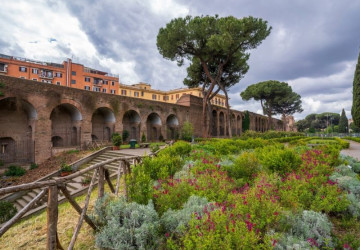
Today, the Aurelian Walls can be seen in various parts of the city, often in excellent condition. Some sections have been restored and opened to the public, offering an immersive experience of Imperial Rome.
One of the best places to explore them is near Porta San Sebastiano, where the Museum of the Walls is located. Here, visitors can walk along the original patrol path, observe the towers, and closely understand how the defensive system worked.
Other interesting locations include:
- the stretch along Viale Pretoriano, near Termini Station
- the walls near Porta San Giovanni, recently enhanced
- the section near Porta Metronia, less touristy but highly evocative
These places offer a more authentic experience compared to the city’s most famous landmarks, away from the crowds and closer to Rome’s historical dimension.
What They Reveal About Imperial Rome
The Aurelian Walls are much more than a defensive structure: they represent a shift in paradigm.
Until the 3rd century, Rome was the heart of an expansive empire, confident in its superiority. The construction of the walls marks the transition to a defensive phase, where the priority was no longer conquest, but protection.
This transformation is reflected in several aspects:
- political, with an increasingly fragile central power
- military, with armies less effective at containing invasions
- economic, with progressively limited resources
- social, with a population living in a climate of uncertainty
The walls thus become the symbol of a Rome in transformation—one that loses part of its sense of security but gains a new awareness of its own fragility.
Why Visit the Aurelian Walls During a Trip to Rome
Visiting the Aurelian Walls means stepping off the beaten path and discovering a different side of Rome—less celebrated, but equally fascinating. It’s an experience that enriches any trip, adding historical depth and new perspectives.
Moreover, the walls help visitors better understand other monuments and districts of the city. Knowing where the boundaries of Imperial Rome once lay allows for a more conscious reading of its urban geography.
For those who love photography, they also offer unique views: contrasts between ancient and modern, light playing on brick surfaces, and unusual perspectives.
How Important the Aurelian Walls Are for Rome’s History
The Aurelian Walls are among the few tangible testimonies of a crucial transitional moment in the history of the Roman Empire. Unlike celebratory monuments, these walls tell a more complex story, one of adaptation, fear, and resilience.
They are also an extraordinary example of military engineering, combining speed of construction, efficiency, and long-lasting durability. The fact that they still stand today, largely intact after nearly two thousand years, is proof of the quality of Roman building techniques.
How to Visit the Aurelian Walls Strategically
Rome is vast and often overwhelming, especially if you want to include less central sites like the Aurelian Walls in your itinerary. For this reason, planning your movements carefully is essential.
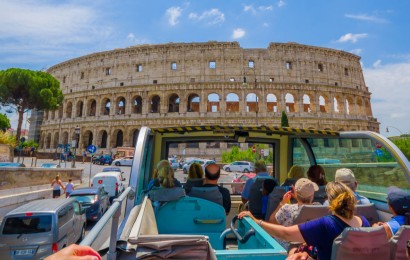
A practical way to optimize your time is to use a hop-on hop-off service, which allows you to move between major points of interest stress-free while enjoying an overall view of the city.
If you want to explore Rome strategically, including less touristy but historically rich areas, you can purchase a hop-on hop-off ticket from Green Line Tours. You’ll have the freedom to get on and off wherever you like, creating a personalized itinerary without wasting time on transportation.