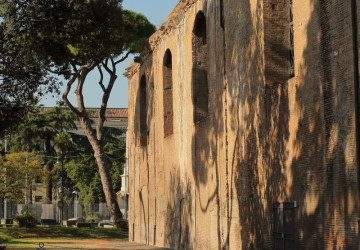
In the heart of Rome, just a short walk from Termini Station, stands one of the most impressive and fascinating archaeological complexes of antiquity: the Baths of Diocletian. Often overshadowed by the city’s more iconic landmarks, they are in fact one of the most extraordinary testimonies to the grandeur of the Roman Empire.
Visiting the Baths of Diocletian means stepping into a place where architecture, history, and everyday Roman life intertwine in a remarkable way. These are not just ruins—they offer a true journey through time, revealing the social and cultural role of bath complexes in ancient Rome.
What are the Baths of Diocletian and why are they so important
Built between 298 and 306 AD under Emperor Diocletian, these baths were the largest ever constructed in Rome. They could accommodate up to 3,000 people at the same time, a number that immediately conveys their scale and significance.
The baths were not merely places for bathing, but true social hubs. Citizens from all walks of life gathered here to relax, exercise, discuss politics, or build relationships. They were a central public space in Roman daily life.
Today, much of the complex is incorporated into the National Roman Museum, allowing visitors to explore well-preserved environments and better understand the original purpose of each space.
Where are the Baths of Diocletian located in Rome
The Baths of Diocletian are located in a strategic area of Rome, between Piazza della Repubblica and Termini Station. This makes them easy to reach both on foot and by public transport.
The main entrance is on Via Enrico De Nicola, but the complex extends over a vast area that also includes later buildings, such as the famous Basilica of Santa Maria degli Angeli e dei Martiri, designed by Michelangelo Buonarroti.
This blend of ancient and Renaissance architecture is one of the most fascinating aspects of the visit. Here, you can clearly see how Rome has reused and reinterpreted its structures over the centuries.
How Roman baths were structured
To fully appreciate the Baths of Diocletian, it helps to imagine how they functioned.
The bathing process followed several stages, each with dedicated spaces:
- Frigidarium: a monumental hall with cold water
- Tepidarium: a room with a moderate temperature
- Caldarium: a hot bath with steam
- Palaestra: an area for physical exercise
- Gardens and libraries: spaces for relaxation and culture
This complex system highlights how advanced Roman engineering was. Thanks to sophisticated heating systems such as the hypocaust, the Romans could manage different temperatures with remarkable precision.
Today, as you walk through the ruins, you can still identify these structures and understand their original function.
What to see at the Baths of Diocletian today
A visit to the Baths of Diocletian is surprisingly rich. Among the highlights are several unique spaces and collections.
The Cloister of Michelangelo is one of the most evocative areas: a Renaissance structure built within the ancient baths, now housing an extraordinary collection of Roman sculptures. The harmony between architecture and artworks creates a timeless atmosphere.
The Octagonal Hall, on the other hand, was likely used as a thermal space or reception hall. Today, it hosts exhibitions that explore specific aspects of Roman culture.
Inside the museum, you will also find important epigraphic collections, mosaics, and artifacts that tell the story of daily life in ancient Rome. This is not a quick visit—you can easily spend several hours here.
Why visit the Baths of Diocletian
There are many reasons to include the Baths of Diocletian in your trip to Rome.
First of all, they offer a different perspective compared to more famous monuments. Here, you don’t just admire the grandeur of the Empire—you connect with the everyday life of Roman citizens.
Moreover, the vastness of the complex allows for a more relaxed experience, often less crowded than other archaeological sites. This makes it easier to explore at your own pace and appreciate the details.
Another key aspect is the historical layering: from imperial baths to Renaissance interventions and the modern museum, each era has left its mark. It’s a place that tells the story of centuries of urban and cultural transformation.
How long does a visit to the Baths of Diocletian take: useful tips
The length of your visit can vary, but it’s advisable to dedicate at least 2–3 hours to explore the complex at a comfortable pace.
A few practical tips:
- Wear comfortable shoes, as the site is extensive
- Consider a guided tour to better understand the spaces
- Don’t miss the Basilica of Santa Maria degli Angeli, included in the visit
- Avoid the hottest hours during summer
Thanks to their central location, the baths can easily be combined with other stops, such as the National Roman Museum or a walk through the Esquilino district.
When to visit the Baths of Diocletian
The Baths of Diocletian can be visited year-round, but the best times are spring and autumn, when the weather is more pleasant.
During summer, high temperatures can make the visit more demanding, especially in outdoor areas. In winter, the atmosphere is quieter and less crowded.
In any case, as part of a museum complex, many areas are indoors, making the visit suitable in any season.
What is the best way to visit the Baths of Diocletian
If you want to fully experience this place without missing anything, the best option is to join an organized tour.
With Green Line Tours, you can visit the Baths of Diocletian with priority access, an expert guide, and a panoramic city tour.
Book your Baths of Diocletian tour with Green Line Tours now and take advantage of:
- skip-the-line entry;
- an expert guide who leads you step by step;
- a panoramic open-top bus tour to discover Rome.
If you’re planning a stay in Rome and want to include something a little different from the usual highlights, the Baths of Diocletian are a perfect choice. And with a guided tour, the experience becomes even more engaging.